


How to Actually Declutter Your Bathroom Counter (Without Sacrificing Hygiene) | NOOK
Bathroom counter clutter builds fast. A few products come out of the cabinet, a couple of things get left after the morning routine, and the sink area turns into a holding zone for anything that doesn’t have a better place.
The usual fix is to buy an organizer and put things in bins. That treats it as a storage problem. Sometimes that’s all it is. But bathroom counters are also hygiene surfaces, and most decluttering advice ignores that entirely.
Start with what actually belongs there
The first step isn’t buying anything. It’s deciding what earns counter space.
Things worth keeping out: items you use daily, multiple times, that are slow or inconvenient to retrieve from storage. Things that need to dry between uses: toothbrush, razor, face wash brush.
Things that can go: products used occasionally but kept out of habit. Duplicates. Decorative items that collect dust and never get wiped. Anything still in packaging.
If you didn’t reach for it in the last three days, it doesn’t need counter space. Cabinet space is effectively unlimited by comparison. The counter is the most active surface in the bathroom. It’s where you do things, not where you store things.
The hygiene problem most organizers create
Counter organizers are good at consolidating clutter into a smaller footprint. They’re less good at what lives inside that footprint.
Bathroom counters get splashed, picked up with damp hands, and accumulate residue quickly. A caddy full of nested products collects the same residue as the counter itself, and it’s harder to wipe down because everything is packed in together.
Keeping items slightly elevated helps. A toothbrush in a cup sits at splash height; one in a holder that positions the head above the waterline doesn’t. Trays and flat caddies are better for dry items (cotton rounds, hair ties, small containers) than for anything that gets wet. Wet items need holders that allow drying, not containers that hold moisture against them.
The toothbrush area
The toothbrush is the highest-maintenance counter item from a hygiene standpoint. It goes in your mouth twice a day, and what happens between uses depends almost entirely on storage.
A cup is the most common solution and one of the worst. Water from the wet brush drips in and stays there. The bristle head sits exposed at counter level. The cup itself accumulates residue, and most people clean it infrequently.
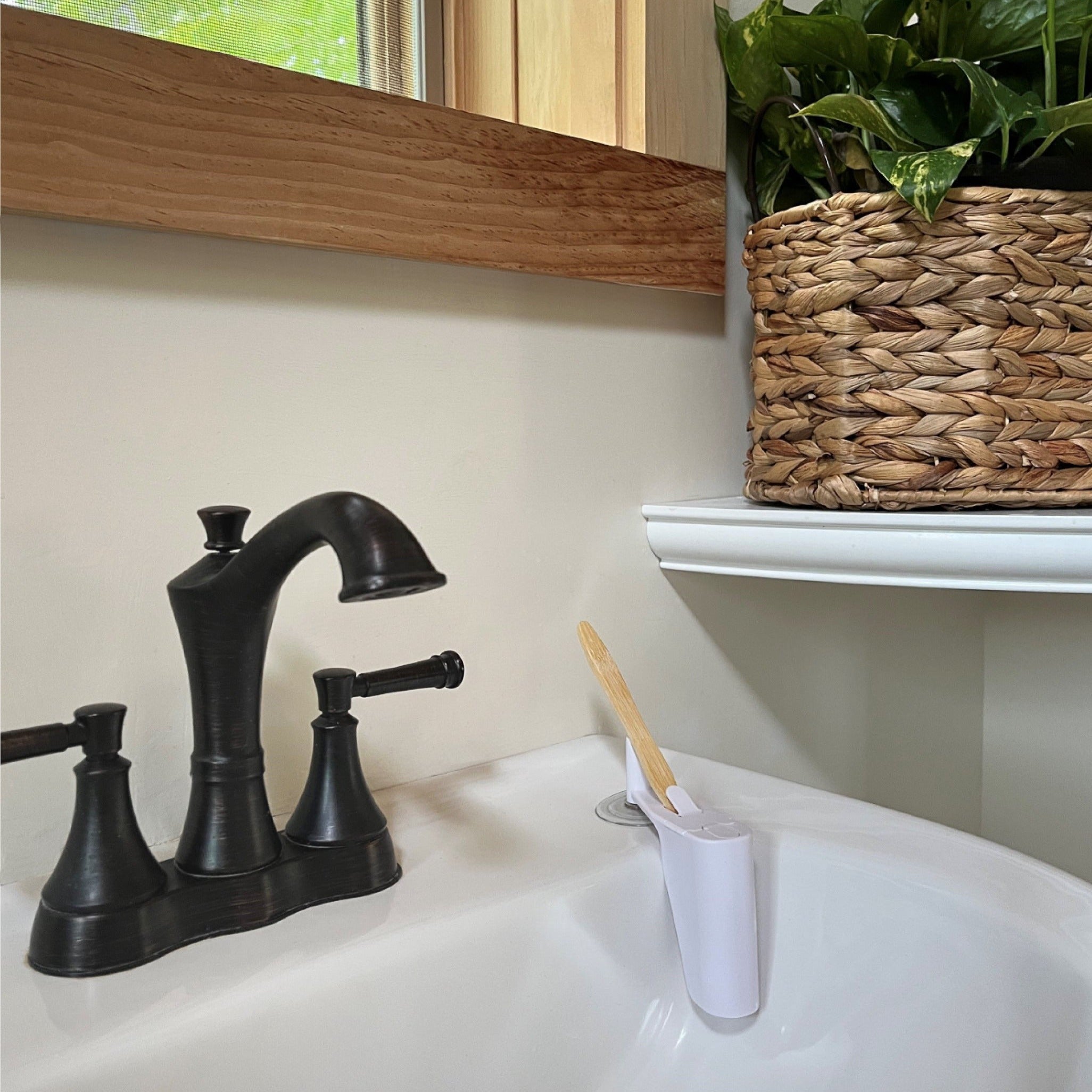
Better: a holder that positions the brush so water drips away from the bristles rather than pooling below them, provides some protection from splash, and is simple enough to actually wipe down regularly. NOOK positions the brush to drip-dry directly into the sink, the shield blocks splashback without sealing in moisture, and there’s no cup or reservoir to deal with. It takes up less counter space than a cup.
Soap and pump bottles
Soap dispensers and pumps collect residue around the base and nozzle. A small tray or silicone mat underneath catches drips and makes the surface easier to wipe. For bar soap, use a dish with drainage channels or raised ridges. A flat plate holds water and the bar dissolves faster.
The razor
Razors stored face-up on the counter or dropped in a cup lose their edge faster and accumulate more residue. Keep them with the head elevated and dry between uses: a wall hook, a handle-grip holder, anything that keeps the blade out of standing water. A closed container keeps a razor wetter longer than open air.
Everything else
Skincare, contacts, whatever else you grab without thinking: a single small tray near the sink corrals it without creating bulk. A 6x4” tray is usually enough. The goal isn’t to display everything; it’s to know where things are so the counter stays clear by default.
The maintenance question
A well-organized counter stays organized if cleaning it takes under two minutes. The failure mode is usually organizers that are awkward to move, ones that require twelve individual lifts before you can wipe the surface.
When setting up your layout, test the cleaning motion. Can you wipe the full counter in one pass? Anything that needs to be lifted and replaced rather than slid aside tends to get skipped during quick cleanups. Small footprint, easy to grip, minimal crevices: those maintain themselves. Dense clusters don’t.
The counter isn’t a storage surface. Fewer things, each with a specific spot, each easy to maintain.
NOOK keeps the toothbrush area of your bathroom counter clean, drip-dry, and simple. Works with manual and electric toothbrushes. Shop NOOK →