

Article: Kids' Toothbrush Holders: What Actually Matters | NOOK

Kids' Toothbrush Holders: What Actually Matters | NOOK
The market for kids’ toothbrush holders is full of cartoon characters and bright colors. Most of them are the same generic countertop cups as adult holders, with a sticker on the side. They look fun. They don’t work any better than the adult version, and in some ways they work worse.
What kids’ brushing routines actually need is different from what most “kids’ holders” are designed for. Here’s what matters and what doesn’t.
What kids’ brushing routines actually look like
Kids brush their teeth with adults nearby, usually at low countertops or kid-height stools, often with electric brushes that are too big for their hands and too heavy for the cups they came with. Bristles get pushed in hard. The brush gets dropped. The cup gets knocked over more than once a week.
Two or three siblings often share a single holder, with brushes ending up touching each other or crammed into a cup designed for two but holding four.
The holder also has to survive being handled by someone who isn’t gentle. A ceramic cup that breaks when it gets knocked off the counter is a bigger problem with a six-year-old than with an adult.
Why most kids’ holders fail
The standard kids’ toothbrush holder is a small cup, sometimes with cartoon graphics, sized for two or three brushes. It has all the problems that adult cup holders have, plus a few specific to kids.
Brushes in shared cups touch. Cross-contamination between siblings is real, especially when one of them is sick. Most cups don’t have any separation, just a single chamber where every brush ends up against every other brush.
The cup catches water in the base. Water from kid-brushed teeth runs down handles the same way it does for adults, and the puddle at the bottom of a kids’ cup stays there for the same reasons. The difference is that kids tend to be louder about not wanting to brush with a sticky-bottomed brush, which is sometimes the only thing that gets the cup cleaned.
Tip-over is a constant issue. Small cups with thin bases and tall brushes are top-heavy. Electric kids’ brushes make this much worse. A holder that tips over puts the bristles directly on the counter, which is the surface a kid most recently set their hand on.
Height matters more than design
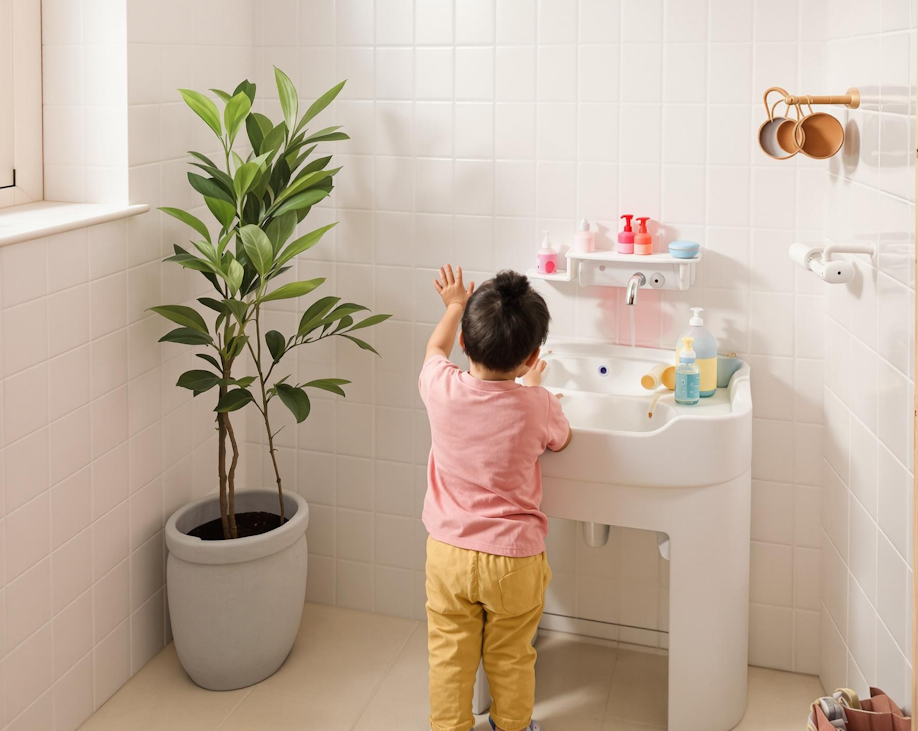
The single most useful thing a parent can do for kids’ brushing is put the holder at the right height.
Counter height is wrong for most kids under eight. They reach up, can’t see the holder clearly, and either knock it over or pull the brush out by the bristles. A stool helps for getting to the sink but doesn’t fix the holder placement.
A wall-mounted holder at the child’s height solves this. The brush is at eye level, easy to grab by the handle, and impossible to knock off the counter because it isn’t on the counter. The mount stays in one place even as the kid gets taller, and the holder doesn’t need to be replaced when the household changes.
For a single bathroom shared between adults and kids, two mounted holders at different heights work better than one shared cup. Each user has their own brush in their own space, and nothing depends on the kid reaching up or the adult bending down.
Separation between brushes
Cross-contamination between siblings’ brushes is the kind of problem that doesn’t show up in a way you’d notice. Siblings share microorganisms anyway through normal household contact, but the toothbrush is one of the few items that goes from one mouth to a shared surface and back again.
A holder that physically separates each brush, with air space between them, removes the brush-to-brush transfer pathway entirely. This matters more when one kid is sick. A separated holder lets the well sibling’s brush stay clear of the sick one’s brush during the days when transmission is most likely.
Slotted cup holders that put brushes in adjacent compartments are better than open cups but not by much. The brushes still touch, just at the bristles now instead of the handles. What actually separates brushes is mounted slots with real space between them.
Electric vs training brushes
Younger kids usually start with manual brushes, then move to electric models as they get older. The transition is when most kids’ holders stop working.
Manual kids’ brushes are small enough that almost anything holds them. Electric kids’ brushes are wider, taller, and heavier than the cups designed around manual brushes can support. The result is a brush that tips, falls, or rolls out of the holder.
A holder that fits both, or that grows with the kid from manual to electric without needing to be replaced, is more useful than a series of holders bought as the kid changes brushes. The same mounting hardware should hold the same brush across the transition.
How NOOK addresses it
NOOK mounts to the wall at whatever height makes sense for the user. For kids, that means installing it at their height, not at adult counter height. The brush sits in a holder they can reach by themselves, with the head shielded and the body in the open.
Each brush has its own slot, separated from the others. Two or three NOOKs side by side at different heights cover a whole family with no shared cups and no cross-contamination between brushes.
The mount holds manual and electric brushes equally well. When a kid moves from a manual training brush to an electric one, the holder doesn’t need to change.
There’s no cup to tip over, no water to pool in the base, and nothing breakable if the holder gets bumped.
NOOK is a wall-mountable toothbrush holder that works for kids, adults, and shared family bathrooms. Separate slots per brush, drip-dry design, mountable at any height. Shop NOOK →