

How to Hang a Toothbrush Holder Without Drilling | NOOK
Renters get told the same thing about bathroom storage. Hooks are temporary. Adhesives ruin the wall. Suction cups fall in the night. Don’t even try.
That’s mostly because the products you find first are designed to fail. A toothbrush holder that mounts without drilling can be just as solid as a drilled-in one, but only if the mounting system is built for the load and you prep the surface correctly. Here’s what actually works and why most adhesive solutions don’t.
Why most adhesive hooks fail
Walk through any drugstore and you’ll find a wall of plastic hooks with foam pads on the back. They cost a few dollars and they’re sold by the dozen because most of them don’t last.
The first problem is the adhesive itself. Cheap foam pads use pressure-sensitive glue that softens in heat and humidity. Bathrooms have both. The glue stays sticky enough to hold the hook for a while, then slowly creeps under load until the hook slides off the wall, usually with no warning.
The second is surface area. A small adhesive pad concentrates the weight of whatever you hang on it onto a few square inches. The smaller the contact patch, the higher the force per square inch, and the faster the adhesive fails.
The third is the wall. Adhesives need a clean, smooth, non-porous surface to bond properly. Textured paint, tile grout, and most painted drywall in older bathrooms are working against the adhesive from the moment it’s installed.
What adhesive mounts actually need
A real adhesive mount, designed for permanent fixtures, looks nothing like a foam-backed plastic hook.
The adhesive itself is usually a structural tape, often called VHB (very high bond), made by 3M and a few other manufacturers. It bonds chemically to the surface over the first 24 to 72 hours and holds permanently after that. It’s the same class of adhesive used to attach trim to cars and signs to buildings.
The mount has a large, flat backplate that spreads the load across more surface area. The bigger the plate, the less stress per square inch, and the more reliably the adhesive holds.
The installation requires actual prep. The wall needs to be cleaned with isopropyl alcohol to remove any soap film, body oil, or cleaning product residue. The mount goes on with firm pressure across the entire backplate, and the bond needs time to cure before anything is hung from it.
A toothbrush holder mounted this way will hold for years and remove cleanly with the right technique when you move out.
Suction cups and when they work
Suction cups have the same reputation as adhesive hooks for similar reasons. The cheap ones fail. The better ones work, but only on the right surface.
A suction cup needs a perfectly smooth, non-porous surface to maintain a seal. Glass and glazed ceramic tile are the only common bathroom surfaces that qualify. Any texture in the tile, any micro-pitting in the glaze, or any soap residue between the cup and the surface lets air in, and the seal fails within hours.
The cup itself matters too. Soft silicone cups conform better and hold longer than hard plastic ones. Locking suction cups that use a lever or twist mechanism to evacuate air after placement create a much stronger seal than push-on cups.
For a toothbrush holder, suction works if you have glass or smooth-tiled walls and you’re willing to re-seat the cup occasionally. It’s not the most reliable option, but it’s the least invasive.
Magnetic options
Magnetic toothbrush holders aren’t a mounting solution on their own. They need something ferrous to attach to, which most bathroom walls don’t provide.
What they’re actually useful for is paired with an adhesive or mechanically mounted backplate. The backplate goes on the wall once, and the holder attaches to it magnetically. The advantage is that you can pop the holder off to clean it without disturbing the mount, then click it back into place.
A magnetic mount is also useful for moving the holder between bathrooms if you have a backplate in each.
Prep the wall first
The single biggest factor in whether a no-drill mount holds is what you do before the mount touches the wall.
The wall needs to be cleaned with isopropyl alcohol, not soap or cleaning spray. Soap leaves a film that interferes with adhesion. Cleaning sprays often contain silicones or surfactants that do the same. Isopropyl alcohol evaporates completely and leaves nothing behind.
The wall also needs to be dry. Humid bathrooms after a shower are the worst time to install anything. Wait until the room has been ventilated for an hour or two, or do the installation in the morning before anyone showers.
The mount itself needs firm, even pressure across the full backplate when applied, held in place for at least 30 seconds. The full bond strength develops over 24 to 72 hours depending on the adhesive. Don’t hang anything from it during that window.
How NOOK addresses it
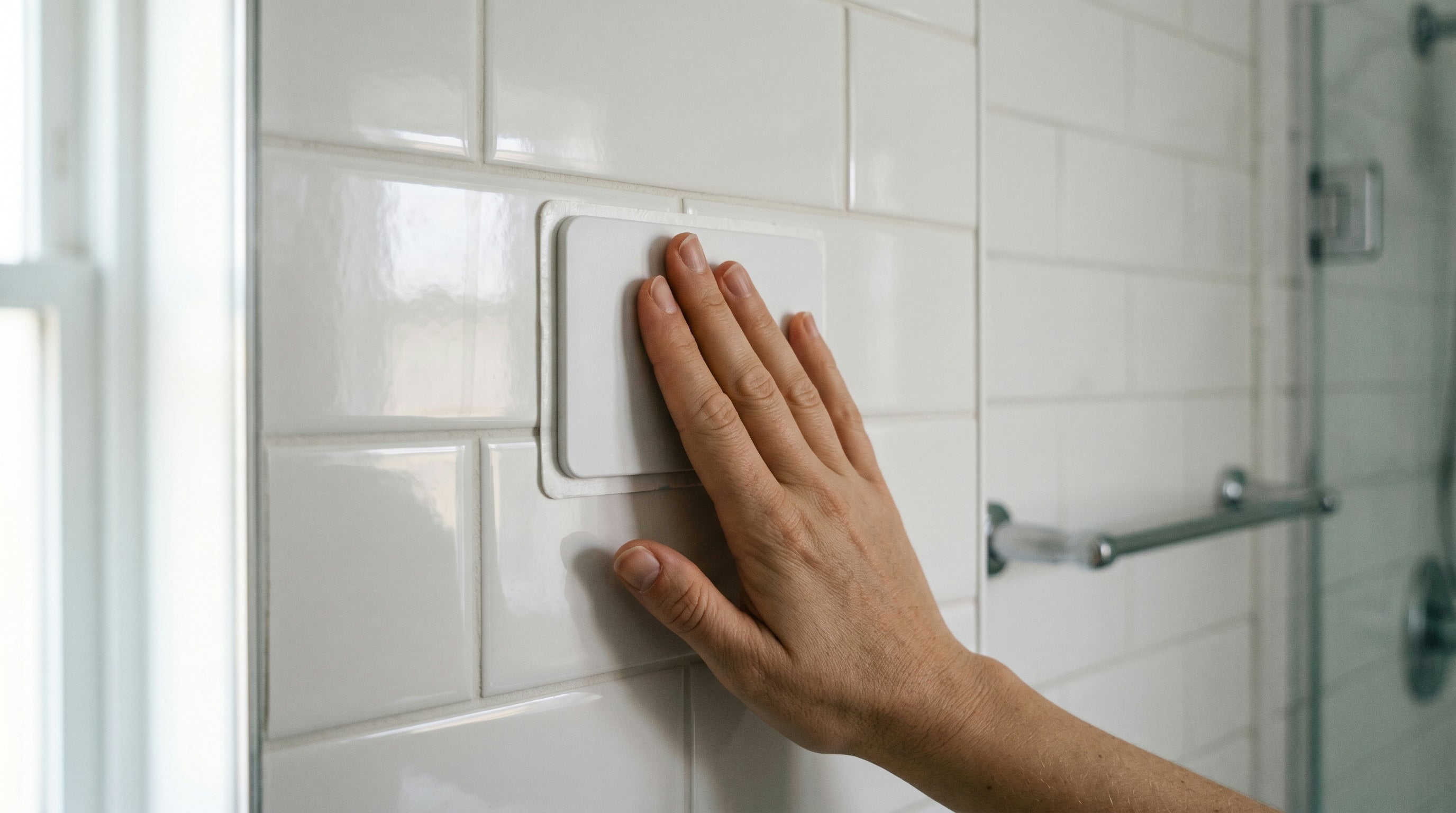
NOOK has a no-drill mounting option built around 3M VHB tape on a large flat backplate. The plate distributes the load across the full surface and the adhesive bonds permanently to clean tile, glass, or smooth painted drywall.
Installation takes about a minute. The wall gets wiped with the included alcohol pad, the plate goes on with firm pressure, and the holder clips onto the plate after 24 hours of cure time. There’s no drilling, no studs to find, and nothing the landlord can object to.
When you move out, the adhesive removes cleanly with the standard 3M removal technique. The plate releases without taking paint or leaving residue.
The holder itself works the same way whether it’s drilled in or adhesive-mounted. The brush drip-dries into the sink, there’s no cup or reservoir to collect water, and air moves around the head on all sides.
NOOK is a no-drill toothbrush holder designed for renters, dorm rooms, and anyone who doesn’t want to put holes in their bathroom. Permanent hold, clean removal. Shop NOOK →